
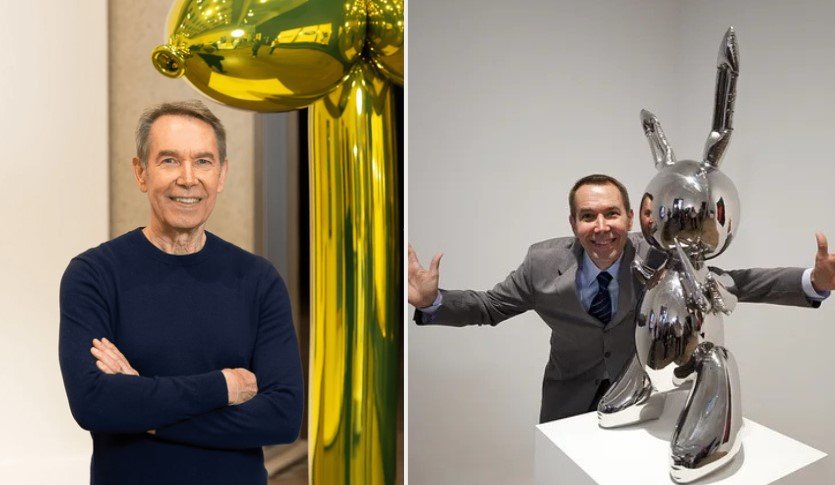
Jeff Koons is an American artist whose oversized sculptures, reflective surfaces, and playful imagery have made him one of the most recognizable figures in contemporary art. His work transforms familiar objects, including balloon animals, toys, and household decorations, into elaborate pieces displayed in museums and galleries around the world. Koons has built a career around the relationship between popular culture, consumerism, beauty, and artistic value. While some critics praise his technical ambition and bold ideas, others question the commercial forces surrounding his work. His sculptures have attracted international attention through major exhibitions, record-breaking auction sales, and collaborations with prominent cultural institutions. From his early experiments with everyday objects to his monumental Celebration series, Koons has continually challenged traditional ideas about what art can be.
Understanding Jeff Koons means looking beyond the striking appearance of his work to examine the ideas, craftsmanship, and debates that shape his artistic reputation.
Quick Bio
| Detail | Information |
|---|---|
| Full Name | Jeff Koons |
| Profession | Contemporary artist and sculptor |
| Nationality | American |
| Birth Date | January 21, 1955 |
| Birthplace | York, Pennsylvania, United States |
| Known For | Balloon sculptures, polished stainless-steel artworks, and pop-inspired installations |
| Artistic Style | Contemporary art, Pop Art influences, appropriation, and conceptual sculpture |
| Education | Maryland Institute College of Art; School of the Art Institute of Chicago |
| Famous Works | Rabbit, Balloon Dog, Puppy, and Michael Jackson and Bubbles |
| Major Recognition | International museum exhibitions and record-setting art auctions |
| Spouse | Not reliably documented here as a current status |
| Children | Publicly reported; details should be checked against reliable biographical sources |
| Current/Public Status | Internationally recognized contemporary artist |
Who Is Jeff Koons?

Jeff Koons is an American contemporary artist who uses recognizable images and objects to question how people understand beauty, luxury, popular culture, and artistic importance. Rather than concentrating exclusively on traditional materials such as bronze, stone, or paint, he has explored stainless steel, porcelain, inflatable objects, and carefully manufactured surfaces.
His art often draws inspiration from things people encounter in everyday life. Balloon animals, decorative figurines, advertisements, and toys become starting points for sculptures that appear familiar but demand attention because of their size, finish, and presentation.
Koons occupies an unusual position in the art world. Major museums and collectors have embraced his work, while critics have debated its meaning, originality, and relationship with wealth. This tension has become an important part of his public identity.
Jeff Koons’ Early Life in Pennsylvania
Jeff Koons grew up in York, Pennsylvania, in a family environment that exposed him to both practical business interests and creative activities. His father operated an interior-design business, while his mother worked as a seamstress. These backgrounds offered different perspectives on design, materials, presentation, and visual detail.
As a young person, Koons developed an interest in art and began exploring how images and objects could attract attention. He later studied at the Maryland Institute College of Art in Baltimore and continued his education at the School of the Art Institute of Chicago.
His education helped him develop a broader understanding of modern and contemporary art. He also encountered artistic approaches that challenged conventional distinctions between fine art, commercial imagery, and everyday life.
How Jeff Koons Developed His Artistic Identity

Koons did not build his reputation by following a single established style. His early career involved experiments with consumer products and ordinary objects, reflecting his interest in how people assign value to familiar things.
After moving to New York, he worked in different professional settings, including a period in which he sold memberships at the Museum of Modern Art. He became familiar with the city’s art scene while developing his own ideas about presentation, taste, and commercial culture.
His early works began to attract attention because they treated ordinary objects as subjects worthy of serious artistic consideration. Instead of hiding their connection to mass production, Koons made that connection central to the work.
This approach eventually became a defining feature of his career: he could take an object associated with shopping, decoration, or entertainment and place it within a context traditionally reserved for fine art.
The Early Series That Established His Reputation
Koons gained greater recognition through several bodies of work that examined consumer culture and the objects people purchase. His Inflatables and Pre-New works used commonplace items and combinations of materials to explore the boundary between everyday products and art.
His The New series, which emerged in the early 1980s, featured new household appliances displayed in carefully controlled arrangements. The presentation encouraged viewers to consider the appeal of pristine products and the desire to preserve objects in an untouched condition.
These works did more than reproduce the appearance of consumer goods. They asked viewers to think about novelty, desire, ownership, and the cultural importance attached to products that promise a better or more attractive life.
Koons continued to develop these questions in later series, using different materials and visual references to examine how people respond to objects.
The Banality Series and the Power of Familiar Images
Koons expanded his reputation in the late 1980s with the Banality series. The works drew on popular imagery, decorative objects, and sentimental figures, challenging the assumption that sophisticated art must avoid accessible or commercially familiar subjects.
One of the series’ best-known works is Michael Jackson and Bubbles (1988), a large porcelain sculpture depicting the singer with his pet chimpanzee. Its glossy finish and elaborate presentation contrast with the ordinary familiarity of celebrity imagery.
The sculpture illustrates Koons’ interest in the relationship between fame, idealized appearance, popular entertainment, and collectible objects. It also demonstrates how he turns a recognizable subject into something that feels both playful and deliberately artificial.
The Banality series generated debate because it blurred boundaries between high art, mass culture, and decorative taste—examining the exact commercial entertainment and media fascinations explored in our retrospective on 1990s screen figure Vanilla Deville. That tension would remain central to Koons’ subsequent work.
Who Is Michael Jackson, and Why Does His Connection to Jeff Koons Matter?
Michael Jackson was an American singer, songwriter, and performer whose music and stage performances made him one of the most influential entertainers of the late twentieth century. His work with the Jackson 5 and his solo albums, including Thriller, established a global audience, while his elaborate music videos and performances helped reshape popular music.
Koons’ connection to Jackson is artistic rather than familial. His sculpture Michael Jackson and Bubbles presents the performer alongside his pet chimpanzee in a highly polished porcelain composition. The work uses the visual language of celebrity portraiture and decorative figurines to examine how famous people become cultural icons.
The sculpture is significant because it brings together two different forms of popular recognition: Jackson’s worldwide celebrity and Koons’ interest in turning familiar images into ambitious contemporary artworks. It also reflects the artist’s broader fascination with fame, spectacle, idealized surfaces, and the objects people collect.
Why Rabbit Became One of Koons’ Most Important Works
Created in 1986, Rabbit is among Koons’ most influential sculptures. The work depicts an inflatable rabbit rendered in highly polished stainless steel, preserving the appearance of a soft, air-filled object in a hard, reflective material.
The sculpture’s simple form hides a complex artistic idea. Its surface reflects viewers and the surrounding environment, making the audience part of the visual experience. The rabbit also connects childhood toys, commercial products, and familiar decorative imagery with the prestige traditionally associated with sculpture.
In 2019, Rabbit sold for approximately $91.1 million at Christie’s, setting an auction record at the time for a work by a living artist. The sale strengthened Koons’ position in discussions about contemporary art and market value.
The work remains important because it captures many of the qualities associated with his career: recognizable imagery, technical precision, visual simplicity, and questions about how the art market determines importance.
The Balloon Dog Sculptures and Their Global Appeal
<PRIVATE_PERSON>’s Balloon Dog sculptures rank among his most recognizable creations. The works resemble balloon animals made for celebrations, but their monumental scale and mirror-like stainless-steel surfaces transform a temporary party decoration into a permanent sculptural object.
The series includes several brightly colored versions, including blue, magenta, yellow, orange, and red. Each sculpture uses carefully engineered forms and reflective surfaces to create the impression of a flexible balloon that has somehow become solid metal.
The contrast between appearance and material gives the series much of its appeal. Viewers recognize the familiar shape immediately, yet the sculpture’s size, finish, and manufacturing complexity make it feel very different from the object that inspired it.
The series also demonstrates Koons’ ability to create work that appeals to a broad audience. Children may respond to the playful shape, while collectors and critics can consider its relationship to consumer culture, industrial production, and the economics of contemporary art.
Puppy: When Art Meets Public Space
Another important work in Koons’ career is Puppy, a monumental sculpture of a West Highland White Terrier covered in living flowers and plants. First presented in 1992, the work combines the familiar appeal of a dog with the scale of a public monument.
Unlike his reflective metal sculptures, Puppy changes with the seasons and requires ongoing horticultural care. Its living surface introduces natural growth into a carefully constructed artistic form, creating a different relationship between art, maintenance, and time.
The sculpture stands outside the Guggenheim Museum Bilbao in Spain, where it has become a recognizable part of the museum’s surroundings. Its cheerful appearance contrasts with the monumental scale often associated with traditional public sculpture.
Puppy shows that Koons’ artistic interests extend beyond polished metal and collectible objects. It also demonstrates how a work can become part of a city’s visual identity and attract visitors who may not otherwise seek out contemporary art.
How Jeff Koons Uses Materials and Technology
Koons’ sculptures often require specialized manufacturing processes and considerable technical planning. Their smooth surfaces may look simple, but achieving precise shapes, consistent finishes, and large dimensions can demand extensive engineering and skilled production teams.
Stainless steel plays a particularly important role in his work. Its reflective surface can make a solid object appear lighter, more fragile, or more fluid than it actually is. The material also reflects viewers and nearby surroundings, continually changing the sculpture’s appearance.
Koons frequently works with assistants, fabricators, and technical specialists to realize ambitious projects. His studio model raises important questions about artistic authorship: how should audiences understand a work when the artist develops the concept and directs its production, while specialized teams carry out much of the fabrication?
For Koons, the planning, design, and controlled realization of an artwork form an essential part of the creative process. For critics, the same process can complicate traditional expectations about the artist’s hand and the meaning of originality.
Jeff Koons’ Artistic Style and Major Influences
Koons’ work is often discussed in relation to Pop Art because of its use of popular imagery, commercial products, and familiar cultural references. However, his approach also draws on ideas associated with conceptual art, appropriation, consumerism, and the presentation of objects.
Rather than presenting ordinary products as inferior to traditional artistic subjects, Koons often gives them monumental scale and meticulous finishes. This approach encourages viewers to reconsider their assumptions about taste and artistic value.
His sculptures frequently use symmetry, smooth surfaces, bright colors, and recognizable shapes. These choices make the work visually accessible, although their interpretation can remain open to debate.
Koons has also discussed the importance of acceptance and communication in his artistic philosophy. His public statements have often emphasized the viewer’s experience and the idea that familiar objects can carry meaning beyond their everyday function.
Why Critics Debate Jeff Koons’ Art
Koons has attracted substantial praise, but his work has also faced criticism. Supporters point to its technical ambition, distinctive visual language, and ability to attract audiences who might find contemporary art intimidating. They see his use of everyday imagery as a way to challenge rigid cultural boundaries.
Critics, meanwhile, question whether the works offer enough conceptual depth to justify their enormous prices and elaborate production. Some also argue that the combination of mass-produced imagery, expensive fabrication, and elite collecting can reinforce the commercial values his work appears to examine.
These disagreements are central to Koons’ reputation. His art often invites immediate recognition, but that accessibility does not guarantee agreement about its meaning or quality.
The debate also highlights a broader issue in contemporary art: the relationship between cultural importance, public popularity, institutional recognition, and financial value. Koons’ career makes those questions difficult to ignore.
Major Exhibitions and International Recognition
Koons’ works have appeared in major museums, galleries, and public spaces around the world. Institutions have presented exhibitions examining his career, while individual sculptures have become prominent attractions in museum collections and outdoor settings.
His work has received attention from the Whitney Museum of American Art, the Centre Pompidou, and other major cultural institutions. The retrospective Jeff Koons: A Retrospective at the Whitney Museum in New York in 2014 brought together works from several stages of his career and highlighted the scale of his artistic development.
His international presence reflects the visual immediacy of his sculptures. Their recognizable forms can attract visitors across differences in language and artistic background, while their materials and cultural references provide opportunities for deeper interpretation.
Institutional recognition does not settle every critical question about his work, but it confirms his lasting place in discussions of contemporary sculpture and the art market.
Jeff Koons’ Net Worth and Financial Life
Jeff Koons operates in a market where major artworks can sell for tens of millions of dollars. The 2019 sale of Rabbit for approximately $91.1 million illustrates the extraordinary prices associated with certain works by the artist.
However, an artwork’s auction price does not establish its creator’s personal net worth. Auction results may involve private collectors, galleries, intermediaries, and other financial arrangements. They also do not account for an artist’s expenses, taxes, assets, or liabilities.
A verified, current figure for Koons’ personal net worth is not reliably established through authoritative public financial disclosures. Online estimates should therefore be treated cautiously rather than presented as confirmed facts.
His commercial success remains an important part of his public profile, particularly because the relationship between art and money is also one of the subjects his work encourages audiences to examine.
Jeff Koons’ Personal Life and Public Profile
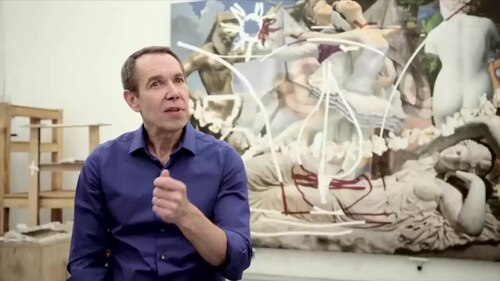
Koons generally maintains a public identity centered on his artwork, exhibitions, and professional projects. Although aspects of his personal life have appeared in public reporting, his artistic career provides the strongest documented basis for understanding his international reputation.
His work has also brought him into contact with prominent cultural figures, collectors, institutions, and commercial partners. These associations reflect the scale of the contemporary art world in which he operates. This fascination with monumental design, aesthetics, and architectural craftsmanship is shared by private art collectors and eco-architects, such as Pierce Brosnan and Keely Shaye Smith in their art-infused Malibu estate.
For readers interested in his biography, it is useful to distinguish confirmed personal information from speculation. His artistic achievements, major works, and documented exhibitions offer a substantial account of his life without relying on unsupported claims about private matters.
Related Reading: Who Is Airyn De Niro? Inside the Life of Robert De Niro’s Daughter
Jeff Koons’ Legacy in Contemporary Art
Koons has helped make contemporary sculpture more visible to audiences beyond specialist art circles. His work often starts with objects people already understand, then transforms them through scale, material, finish, and presentation.
His influence can be seen in ongoing conversations about consumer culture, celebrity, artistic labor, and the commercial art market. This interdisciplinary approach continues to inspire the current generation of visual artists, including multidisciplinary artist Grace Fan DeVito, whose work bridges performance, installation, and visual expression. Whether audiences admire or criticize his approach, his sculptures regularly prompt questions about what deserves a place in a museum and why.
His legacy will likely remain contested rather than universally agreed upon. That tension is part of what makes his career significant: Koons has created artworks that are easy to recognize but difficult to separate from larger debates about taste, money, and culture.
Conclusion
Jeff Koons has built an influential career by transforming familiar objects into ambitious contemporary sculptures. From Rabbit and the Balloon Dog series to the flower-covered Puppy, his work combines playful imagery with sophisticated materials and complex production methods.
His sculpture of Michael Jackson and Bubbles demonstrates how he uses celebrity and popular culture to explore the way society creates icons. More broadly, his career has challenged traditional boundaries between fine art, commercial imagery, public entertainment, and luxury collecting.
Although critics continue to debate the meaning and value of his work, Koons remains a significant figure in contemporary art. His career shows how an ordinary object can become the starting point for a much larger discussion about creativity, culture, and the meaning of art.
FAQs
Who is Jeff Koons?
Jeff Koons is an American contemporary artist known for large-scale sculptures inspired by toys, balloon animals, consumer products, and popular culture. His work often explores beauty, celebrity, consumerism, and artistic value.
What is Jeff Koons famous for?
Koons is famous for sculptures such as Rabbit, Balloon Dog, Puppy, and Michael Jackson and Bubbles. His works combine recognizable imagery with polished materials and ambitious production techniques.
What is the connection between Jeff Koons and Michael Jackson?
Koons created Michael Jackson and Bubbles in 1988, a porcelain sculpture depicting the singer with his pet chimpanzee. The work reflects Koons’ interest in celebrity, popular culture, and idealized appearances.
How much did Jeff Koons’ Rabbit sell for?
Rabbit sold for approximately $91.1 million at Christie’s in 2019. At the time, the sale set an auction record for an artwork by a living artist.
What is Jeff Koons’ most famous artwork?
Several works compete for that distinction, particularly Balloon Dog, Rabbit, and Puppy. Their international visibility and distinctive designs have made them central to his public reputation.
What is Jeff Koons’ artistic style?
Koons’ style combines contemporary sculpture, Pop Art influences, conceptual ideas, and imagery drawn from consumer culture. He often transforms familiar objects through reflective materials, monumental scale, and carefully controlled presentation.
What is Jeff Koons’ net worth?
A verified current net worth figure is not reliably established through authoritative public financial disclosures. His high-value auction sales demonstrate the commercial importance of his art but do not reveal his personal wealth.
Explore More In-Depth Profiles: Visit Individual Magazine for stories on Hollywood families, art icons, and cultural figures.

Leave a Reply